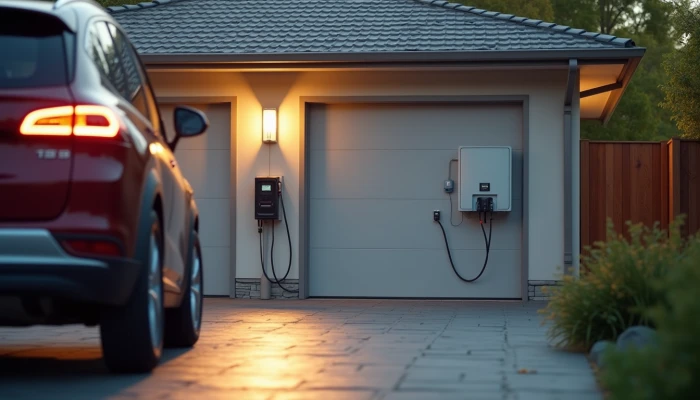
How to Make Ev Charging Work Smoothly with a Home Battery
Adding an EV to a house that already has solar or battery backup can change how energy moves through your home. Instead of one major electrical load, you now have another large demand that may compete with household use, battery charging, or backup reserves.
That does not mean you need a complicated setup. In most homes, the key is to make a few clear decisions: whether your equipment is compatible, when the car should charge, and which loads should get priority when power is limited.
This guide explains those decisions in plain language. It focuses on how a home battery system can work alongside EV charging, especially when you want to use solar production wisely, avoid unnecessary battery cycling, and keep critical home loads protected during outages.
The exact settings depend on your inverter, battery, EV charger, utility rate plan, and whether your vehicle supports newer features such as bidirectional charging or vehicle to home. Because those details vary, use this article as a planning guide and confirm final setup choices with your installer, electrician, charger manufacturer, and battery manufacturer.
System Compatibility Checks for Home Batteries and EV Chargers
Before you think about schedules, start with compatibility. A battery, inverter, solar array, EV charger, and vehicle may all be individually capable, but that does not automatically mean they will coordinate well together.
The first check is the inverter. In many homes, the inverter is the traffic manager for solar production, battery charging, battery discharge, and backup operation. Review its specifications to see whether it supports EV charger integration, load management, or communication with external devices. If you are exploring bidirectional charging, confirm that the inverter and the vehicle are both designed for that use case. Department of Energy guidance makes clear that bidirectional operation is a distinct capability, not a default feature on every EV or charger.
The second check is manufacturer guidance. Look for compatibility documents, installation manuals, and support notes that address:
- approved EV charger pairings
- supported communication methods
- export or backup limitations
- whether the system can coordinate charging around battery state of charge
- whether special controls are required for vehicle-to-home functions
Do not assume that two products are compatible just because they are popular or use similar terms in marketing.
The third check is capacity under real household conditions. Your battery may be able to support some EV charging, but the important question is whether it can do that while serving home loads. A charger can add a large continuous demand. If your home is also running air conditioning, a well pump, kitchen loads, or other major appliances, the system may need to reduce charging speed or stop EV charging altogether.
Use this quick compatibility checklist before discussing settings with an installer.
- Confirm your inverter's maximum continuous output.
- Confirm your battery's usable capacity and discharge limits.
- Check whether your charger supports scheduling, current limits, and load management.
- Verify whether your EV supports managed charging only, or also bidirectional features.
- Ask whether the system can prioritize critical loads during outages.
- Ask how the system behaves if solar production drops suddenly.
- Confirm whether any added controls, software, or gateway equipment are required.
A simple way to think about compatibility is to separate three questions:
| Question | Why it matters |
|---|---|
| Can these devices communicate? | Coordination often depends on software, controls, or approved integrations. |
| Can the system handle the power? | Charging demand may exceed what the battery or inverter can supply at one time. |
| Can the system follow your priorities? | Backup reserves, solar use, and EV charging goals may conflict without clear rules. |
If any one of those answers is unclear, pause before moving on to scheduling. It is much easier to plan around known limits than to discover them during an outage or a high-load evening.
Smart Charger Scheduling Strategies
Once compatibility is confirmed, scheduling is where most households get the biggest practical benefit. The goal is not to chase perfect optimization. It is to charge the EV when energy is most available or least costly, while protecting battery reserves for the home.
A good starting point is to match charging windows to your home's energy pattern. In many homes, that means some combination of:
- midday charging when solar production is strongest
- overnight charging during lower utility rates, if your plan includes time-of-use pricing
- reduced or paused charging during high-demand evening hours
Many smart chargers and vehicle apps let you set a start time, stop time, target state of charge, or finish-by time. Those features can be more useful than simply charging as soon as the car is plugged in.
For example, if your battery is meant to cover evening household use, immediate charging after work may drain stored energy at the exact time you want to preserve it. A delayed charging schedule can shift that demand to a later period, or to the next solar window, depending on your priorities.
A practical scheduling sequence looks like this.
- Define when the EV actually needs to be ready.
- Identify your lowest-cost or highest-solar charging window.
- Set a target charge level instead of always charging to full, if that fits your driving needs and vehicle guidance.
- Reserve battery capacity for critical household use before allowing discretionary EV charging.
- Recheck the schedule seasonally, because solar production and household loads change.
If your charger or energy management platform supports automation based on battery state of charge, that can help avoid unnecessary battery drain. For instance, some systems can allow EV charging only after the home battery reaches a chosen reserve level, or can reduce charging current when household demand rises.
This is also where direct solar charging can matter. Some smart charging guidance notes that charging the car directly from available solar can avoid extra conversion losses that occur when solar first charges the home battery and the battery later discharges into the EV. In plain terms, if the sun is available and the car is home, direct use can be more efficient than routing everything through storage first.
That said, convenience still matters. If your vehicle is only home overnight, your best schedule may rely more on utility rates and battery reserve settings than on solar timing.
Use this simple planning framework to choose a schedule.
| Home situation | Scheduling priority |
|---|---|
| Strong midday solar and daytime parking at home | Charge during solar production first |
| Time-of-use utility plan with cheap overnight rates | Shift charging to off-peak hours |
| Frequent outages or backup concerns | Protect battery reserve before EV charging |
| Heavy evening home loads | Avoid full-speed charging during peak household demand |
| Variable daily driving | Use finish-by or target-charge settings instead of fixed full charges |
The main mistake to avoid is treating the EV charger as separate from the rest of the house. In an integrated setup, charging is part of your home's overall energy plan, not just a vehicle task.
Energy Routing Priorities for Home Batteries and EVs
After compatibility and scheduling, the last step is deciding what gets power first. This is your energy routing strategy.
In a home with solar, battery storage, and EV charging, there are usually four competing destinations for electricity:
- current household loads
- charging the home battery
- charging the EV
- exporting power or reducing grid use, depending on system design
Most homeowners benefit from setting clear priorities rather than trying to maximize everything at once.
A practical default is:
- Keep essential household loads powered.
- Maintain the battery reserve needed for backup.
- Use extra solar for EV charging when available.
- Use grid charging strategically when needed for transportation needs.
This matters most during outages or constrained conditions. If your system is in backup mode, EV charging may need to stop so the battery can support refrigeration, lighting, internet, medical-adjacent household essentials, heating controls, or well and sump equipment where applicable. Some implementation guidance for integrated systems emphasizes that household needs should take priority when available power is limited.
If your setup includes a critical loads panel, ask your installer exactly which circuits are protected and how EV charging is treated during backup operation. In many homes, the EV charger is not part of backup loads, and that is often intentional. It prevents the vehicle from consuming stored energy needed elsewhere.
Charge limits also play an important role. You do not always need the charger running at its maximum rate. Lower current settings can reduce strain on the system and help the battery, solar production, and home loads coexist more smoothly. This can be especially useful in homes with smaller service capacity or multiple large electric loads.
Here is a simple mistake-to-avoid table.
| Routing mistake | Why it causes problems | Better approach |
|---|---|---|
| Letting the EV charge immediately at full power every time | Can compete with home loads and drain battery reserves | Use scheduled charging and current limits |
| Treating the battery as unlimited | Stored energy is finite and may be needed for outages | Set a minimum backup reserve |
| Sending solar into the battery first by default | Can add conversion losses before EV charging | Use direct solar charging when your system supports it and timing works |
| Assuming vehicle-to-home works automatically | V2H requires specific vehicle, charger, and system support | Verify approved compatibility before planning around it |
| Ignoring circuit and service limits | Can trigger load conflicts or system restrictions | Ask for a load management review |
If you are considering EV backup power through vehicle to home, be especially careful about assumptions. The concept is promising, but support varies widely by vehicle, charger, and home energy equipment. Some systems can discharge from the vehicle to support home loads, while others only support one-way charging. Even when the vehicle hardware is capable, the home still needs the proper control equipment and approved configuration.
The best routing setup is usually the one that reflects your real priorities. If outage resilience matters most, preserve battery reserve and limit EV charging during tight periods. If transportation reliability matters most, schedule enough charging to meet daily driving while still protecting essential home loads. The right balance is not the same for every household.
Conclusion
Integrating a battery with EV charging works best when you keep the process simple: confirm compatibility, set smart charging schedules, and decide in advance which loads get priority.
Those three steps help prevent the most common problems, such as charging the car at the wrong time, draining battery reserves needed for the house, or assuming that solar, storage, and EV equipment will coordinate automatically.
If you already have equipment installed, your next move is to gather the inverter, battery, charger, and vehicle documentation and compare their supported features. If you are still planning a system, ask installers to explain exactly how charging schedules, backup reserves, and energy routing priorities will work in normal use and during outages.
Because these systems involve real power limits, software controls, and local code requirements, final configuration should be reviewed by a qualified electrician or installer. That extra verification can help you build a setup that is practical, predictable, and easier to live with.