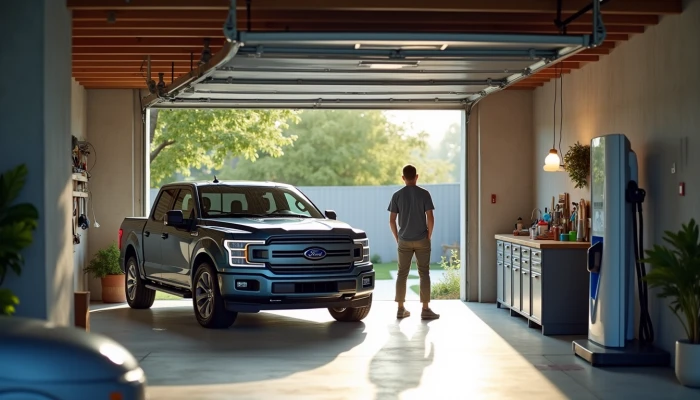
Can Your Ev Keep the Lights on During an Outage?
If you already own an EV, it is reasonable to ask whether that battery can do more than drive. In some cases, it can help with home battery backup during an outage. The key is understanding that not every EV, charger, or home setup supports that job.
Vehicle-to-home systems can be useful, but they are not automatic and they are not universal. You need a compatible vehicle, the right charging and home-integration equipment, and a realistic plan for what loads you want to support.
This guide explains how vehicle to home systems work, what to check before you count on one, and where the practical limits show up in real use.
What Is Vehicle-to-Home (V2H) Technology?
Vehicle-to-home, usually shortened to V2H, means an EV can send electricity back out of its battery to support part of a home. Instead of only charging from the grid, the vehicle can also discharge energy in the other direction when the system is designed for it.
That bidirectional flow is what makes V2H different from ordinary EV charging. A normal charger moves power one way: into the car. A V2H setup uses specialized hardware so the car battery can act more like a stationary backup battery when needed.
It helps to separate V2H from a similar term, V2L.
- V2H connects the vehicle to home circuits through dedicated integration equipment.
- V2L stands for vehicle-to-load and usually powers individual devices or appliances directly from outlets on the vehicle.
- V2L can be useful for temporary backup, but it is not the same as supplying selected circuits through your home's electrical system.
In plain terms, V2H is the more integrated option. It is closer to a home battery system, while V2L is closer to plugging appliances into a portable power source.
That distinction matters because many people hear that an EV can power a house and assume any EV can do it the same way. In practice, the level of backup depends on the vehicle, the charger, and the home connection method.
EV Compatibility: Which Vehicles Support V2H?
Compatibility is the first filter. Not every EV supports bidirectional charging, and not every model that can export power does it in the same way.
Some vehicles are designed with V2H or related backup features in mind. Others may support V2L only. Some may need additional integration equipment, and some may not be practical candidates at all.
Before you assume your EV can provide backup power, check these points:
- Whether the manufacturer explicitly states support for vehicle to home, V2H, or bidirectional charging
- Whether the vehicle supports only V2L rather than home integration
- Whether support depends on a specific trim, battery size, software version, or charging standard
- Whether the feature is available in your market and with approved equipment
- Whether the manufacturer requires a specific home integration kit or certified installer pathway
A few commonly discussed examples in V2H conversations include the Ford F-150 Lightning, Nissan Leaf, and Volkswagen ID.4, but even with well-known models, details can vary. Support may depend on charger type, connector standard, or local rollout.
Some sources also describe retrofit-style approaches for vehicles that are not designed for straightforward V2H use. That does not mean every non-V2H EV is a practical candidate. It usually means the setup becomes more specialized, more dependent on approved hardware, and more important to verify with the automaker and installer.
A simple way to think about compatibility is this:
| Question | Why it matters |
|---|---|
| Does the EV support bidirectional charging? | Without it, the car may not be able to send power back out in a usable way. |
| Is the feature V2H or only V2L? | Powering a few devices is different from backing up home circuits. |
| Is there approved home integration equipment? | The vehicle alone is not enough. |
| Are there manufacturer conditions or limits? | Some systems only work with specific hardware or installation methods. |
If you cannot confirm those answers in manufacturer materials or with a qualified installer, treat the vehicle as unconfirmed for home backup planning.
System Requirements for V2H Setup
A working V2H setup needs more than a parked EV. The home side matters just as much as the vehicle side.
At a minimum, implementation guidance commonly points to three pieces:
- A compatible EV that can discharge power outward
- A bidirectional charger or approved home integration equipment
- A safe way to connect selected home circuits, often through a transfer switch or critical loads arrangement
Some guidance also points to standards such as ISO 15118 as part of the broader push toward charger and vehicle interoperability. That is useful context, but it does not replace model-specific compatibility checks.
For most households, the practical setup conversation includes these questions:
- Which loads do you want backed up?
- Will the system support only essential circuits or a larger portion of the home?
- Does your electrical panel need modifications?
- What equipment does the automaker or charger maker approve?
- What permits, inspections, or utility requirements apply locally?
A critical loads panel is often the most realistic approach. Instead of trying to support every circuit, it separates the essentials you care about most, such as refrigeration, lighting, internet equipment, garage access, or a few outlets.
That matters because V2H is usually strongest as a selective backup strategy, not as a promise that the car will run everything in the house.
This is also where professional installation becomes important. Hardwired backup systems involve electrical integration, safety controls, and code compliance. A licensed electrician or qualified installer can confirm whether your panel, charger location, and outage goals line up with what the vehicle and equipment can actually do.
Energy Transfer Limitations and Real-World Use
The biggest planning mistake is assuming a large EV battery automatically means whole-home backup. Battery capacity matters, but power output limits and household loads matter just as much.
In many practical examples, EV-based backup is limited to something like 7.2 to 9.6 kW. That can be enough for many essential loads, but it does not mean every large appliance can run at once. Startup surges, heating loads, and central air conditioning can change the picture quickly.
A more useful planning method is to separate capacity from power:
- Capacity is how much energy the battery stores, often measured in kWh.
- Power is how much electricity the system can deliver at one time, often measured in kW.
You need enough of both. A large battery with limited output still cannot run every circuit at once.
Here is a simple reality check for outage planning:
| Load type | V2H fit |
|---|---|
| Refrigerator, lights, internet, phone charging | Often a reasonable target |
| Small kitchen appliances used one at a time | Sometimes workable, depending on output limits |
| Well pump or sump pump | Possible in some homes, but startup demand needs checking |
| Electric water heater, large HVAC, multiple heavy loads at once | Often where limits show up fast |
Battery depletion is the other major limit. If the outage lasts longer than expected, using too much of the EV battery can leave you with less transportation range when you may need it most.
One commonly cited example helps show the math. If an EV has a 77.5 kWh battery and you preserve a 20% reserve, about 62.5 kWh remains usable for backup. At a steady 500-watt essential load, that could last about 125 hours, or a little over five days.
That sounds impressive, but the example only works if your loads stay low and steady. Real homes are rarely perfectly steady. Refrigerators cycle, pumps surge, and people tend to use more power than expected during an outage.
So the practical takeaway is simple: EV backup power works best when you define critical loads carefully and avoid treating the vehicle like unlimited emergency power.
Cost and Practical Considerations
Cost is not just about the charger. It can include home integration equipment, panel work, labor, and any required permitting or inspection. Some published estimates place installed V2H-style setups in roughly the $3,500 to $6,000 range, but actual pricing can vary with the home and the vehicle.
Just as important, V2H only helps when the car is available. If the EV is away from home, or not plugged in when the outage starts, the backup plan may not work the way you expected.
Use this checklist before you move forward:
- Confirm your EV supports V2H, V2L, or another export-power feature
- Verify whether support depends on specific hardware or software
- Decide which circuits you actually want to back up
- Ask whether a transfer switch or critical loads panel is needed
- Check expected power output, not just battery size
- Ask how much battery reserve you want to keep for driving
- Confirm local permitting, inspection, and utility requirements
- Get installation guidance from qualified professionals, not assumptions from general EV discussions
For some households, V2H may be a strong supplement to a broader home energy storage plan. For others, it may be a niche backup option that works only if the vehicle is regularly parked at home and the outage plan focuses on essentials.
The practical value is real, but only when expectations are realistic. Think of EV backup as a conditional tool, not a universal substitute for every other backup power approach.
Conclusion
Using an EV for backup power can be a smart option, especially if you already own a compatible vehicle and want another layer of resilience without adding a separate battery right away.
But V2H is not automatic. It depends on vehicle compatibility, approved hardware, safe home integration, and careful load planning. It also works best when you accept the limits: the car must be home, plugged in, and able to spare battery energy without creating a transportation problem later.
If you are considering this route, the next practical step is not shopping by headline claims. It is confirming compatibility with your automaker, reviewing your critical loads, and talking with a qualified installer about what your home can support safely.