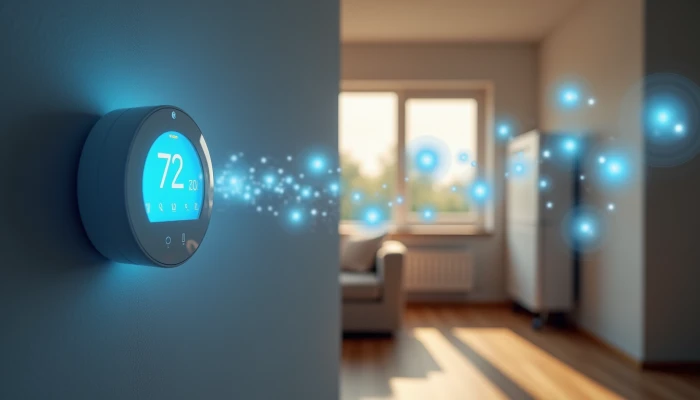
How a Smart Thermostat Can Make Solar and Battery Backup More Useful
A smart thermostat does not control your solar panels directly in the same way it controls your heating or cooling equipment. What it can do is respond to information from the rest of your home energy setup and shift when your HVAC system runs.
That matters because heating and cooling are often among the biggest electrical loads in a home. If your thermostat can pre-cool, pre-heat, or reduce runtime when battery charge is low, your solar and storage setup may be able to cover more of the energy you actually care about.
For homeowners comparing a home battery system, this is often the missing piece. The question is not only how much battery backup do I need. It is also how intelligently the house uses that stored energy.
This guide explains how the pieces usually connect, what load-shifting means in everyday terms, and what outage scenarios are realistic. The goal is not to promise savings or whole-home backup. It is to help you understand the tradeoffs before you talk with an installer or HVAC professional.
Communication Between Smart Thermostats and Solar/Battery Systems
In most homes, the thermostat is not talking straight to the solar panels themselves. Instead, it usually connects through apps, cloud platforms, home energy management software, or automations that pull data from the inverter, battery controls, or an energy monitor.
In plain language, the system works like this:
- The solar inverter tracks how much solar power your panels are producing.
- The battery system tracks state of charge, which is the battery's current stored energy level.
- An energy monitor or smart home platform watches household usage.
- The thermostat receives a rule, signal, or schedule change based on that information.
A common example is midday cooling. If the inverter shows strong solar production, the system may allow the thermostat to cool the house a little earlier than usual. That stores comfort in the building itself while solar power is available, instead of waiting until evening when solar output drops.
This does not always require a direct thermostat-to-inverter wire. In many setups, the connection is indirect. The thermostat may respond to:
- a utility or time-of-use schedule
- a smart home automation platform
- a battery app with load-management features
- an energy monitor that triggers routines at certain thresholds
Compatibility is the part that often gets overlooked. A thermostat, inverter, battery, and HVAC system may each work well on their own but still not share useful data without the right software or integration path. Manufacturer documentation commonly emphasizes checking whether the inverter has monitoring support, whether the battery platform exposes usable controls, and whether the thermostat can accept external scheduling or automation inputs.
Here is a simple way to think about the communication path:
| System part | What it knows | What it may tell the thermostat |
|---|---|---|
| Solar inverter | Current solar production | "Solar is high right now" |
| Battery controls | Battery charge level | "Conserve energy" or "use stored power carefully" |
| Energy monitor | Whole-home usage | "Loads are rising" or "peak use is starting" |
| Thermostat | Indoor temperature and schedule | Adjust HVAC runtime or setpoint |
The practical takeaway is that the thermostat acts more like a smart responder than a power source. It helps align comfort with available energy, but only if the rest of the system can share useful information in a compatible way.
Benefits of Load-Shifting With Battery Storage
Load-shifting means moving electricity use from one time of day to another. With heating and cooling, that usually means running the HVAC system when solar production is strong, when utility rates are lower, or when battery discharge is planned, instead of letting it run hardest during the most expensive or most constrained hours.
This is where a battery adds flexibility. Solar alone only helps when the sun is producing. Battery storage extends that benefit into the evening or during a short outage. A smart thermostat can then use that flexibility in a more deliberate way.
Common load-shifting patterns include:
- pre-cooling the house in late morning or early afternoon when solar output is high
- pre-heating before a peak pricing window starts
- relaxing the temperature setpoint slightly when battery charge falls below a chosen threshold
- reducing HVAC demand so the battery can preserve power for critical loads
That last point is important. In a limited backup situation, comfort and resilience can compete with each other. If the battery is small relative to the home's loads, running central air aggressively may leave less energy for refrigeration, lighting, communications, medical support equipment that follows official guidance, or a well pump.
A thermostat cannot solve undersized storage, but it can help you use available storage more carefully. That is one reason the question "how much battery backup do I need" should be paired with a usage question: which loads can be shifted, reduced, or scheduled?
A simple planning sequence looks like this:
- Identify whether your utility uses time-of-use pricing or other peak periods.
- Review your HVAC energy use with an energy monitor or utility usage data.
- Ask whether your battery platform supports load management or automation.
- Decide which comfort changes are acceptable, such as a small temperature adjustment.
- Size expectations realistically using a home battery size calculator or installer estimate.
If you are comparing options, this table can help frame the tradeoff:
| Goal | What the thermostat may do | Why the battery helps | Main limitation |
|---|---|---|---|
| Use more solar directly | Cool or heat earlier in the day | Stores extra solar for later hours | Needs good timing and compatible controls |
| Reduce peak grid use | Shift HVAC away from expensive hours | Covers some evening demand | Savings depend on your rate plan |
| Stretch outage runtime | Ease back HVAC demand | Preserves charge for critical loads | Comfort may be reduced |
| Improve daily control | Adjust based on occupancy and energy data | Adds flexibility after sunset | Not every system integrates cleanly |
Research and industry guidance on home energy management often describe this as coordinated control: the thermostat manages a large flexible load while the battery manages when stored energy is used. The benefit is not unlimited backup. The benefit is better timing.
Outage Resilience Scenarios
During an outage, the thermostat's job changes. Instead of helping you time energy use for convenience or lower rates, it may need to help your home stay livable without draining the battery too quickly.
What happens depends on your backup design. Some homes have a critical loads panel that only powers selected circuits during an outage. Others have partial-home backup through specific subpanels. Some have whole-home backup capability, but even then, battery output and stored energy still have limits.
Here are a few realistic scenarios.
Scenario 1: Mild weather, partial-home backup
If outdoor temperatures are moderate, the thermostat may be able to maintain a smaller comfort range with limited battery use. In this case, the system may keep one HVAC zone active, or cycle heating and cooling less often, while preserving energy for refrigeration, internet equipment, and lighting.
Scenario 2: Hot afternoon outage with strong solar
If the outage happens while solar is still producing and the battery is charged, the thermostat may continue normal or near-normal cooling for a while. An energy monitor or automation rule may then reduce cooling demand later in the day as solar production drops and battery state of charge declines.
Scenario 3: Overnight outage with limited battery reserve
This is where smart control matters most. The thermostat may widen the temperature setpoint, reduce fan usage, or stop conditioning unused rooms if the HVAC setup allows zoning. That can help the battery last longer, though not every home has the equipment needed for room-by-room control.
Scenario 4: Rural home with a well pump or other heavy loads
A battery may need to prioritize short, high-value loads over continuous comfort loads. In that situation, the thermostat may be set more conservatively so stored energy remains available for water access, refrigeration, or other essentials.
A useful outage planning checklist is:
- Confirm whether your HVAC equipment is actually on backed-up circuits.
- Ask your installer which thermostat functions continue if internet service drops.
- Check whether your system can respond to battery state-of-charge thresholds.
- Decide which rooms or temperature ranges matter most during an outage.
- Review whether an energy monitor can help you see real-time battery drain.
- Verify settings with qualified professionals before relying on them in an emergency.
One common misunderstanding is that a smart thermostat alone creates resilience. It does not. Resilience comes from the backup architecture: battery capacity, inverter output, backed-up circuits, HVAC startup requirements, and control logic.
The thermostat helps by making smarter decisions inside those limits. That can make an outage feel more manageable, but it does not remove the need to size the system carefully or verify compatibility with your installer, electrician, utility, and equipment documentation.
Conclusion
Smart thermostats can make solar and battery storage more practical by shifting heating and cooling to better times, responding to battery conditions, and helping preserve stored energy during outages. The value is usually not in flashy automation. It is in small, sensible adjustments that match comfort needs to available power.
The main limits are compatibility and load size. Not every thermostat can work with every inverter, battery platform, or HVAC setup. And no control strategy changes the basic fact that air conditioning, heat pumps, furnaces with blowers, and other comfort systems can use a meaningful share of your backup power.
If you are planning a system, ask for a clear explanation of how the thermostat, inverter, battery controls, and any energy monitor will work together. If you are already using a home battery system, review whether simple schedule changes or threshold-based automations could improve comfort without overusing stored energy.
For anything involving hardwired backup, panel configuration, or code compliance, verify the details with qualified electricians, HVAC professionals, installers, manufacturers, and local authorities.