Portable Power Stations or Home Batteries: What Makes More Sense for Renters?
Backup power is harder to plan in an apartment than in a detached house. You may want to keep phones charged, preserve food, power a router, or ride out short outages more comfortably. But renters usually face limits that homeowners do not: no panel upgrades, no permanent equipment, less storage space, and the need to move everything when the lease ends.
That is why the usual backup-power conversation changes for this audience. A portable power station can often be used right away with no building changes, while a home battery backup system is designed around permanent installation and deeper integration with the home's electrical setup.
Neither option is automatically better. The right fit depends on how much power you need, how long outages usually last, whether your landlord would allow any fixed equipment, and whether you want something you can take with you later.
This comparison focuses on the practical questions renters ask most:
- Which option is actually apartment-friendly?
- How different are the real costs?
- What is safer to use indoors?
- When is a portable unit enough, and when does a larger home battery system make sense?
If you are still estimating your needs, think first about your critical loads rather than your whole apartment. For many renters, the goal is not whole-home backup. It is keeping a short list of essentials running during an outage.
Apartment-Friendly Features: Portability vs Permanent Installation
For most renters, portability is the deciding factor.
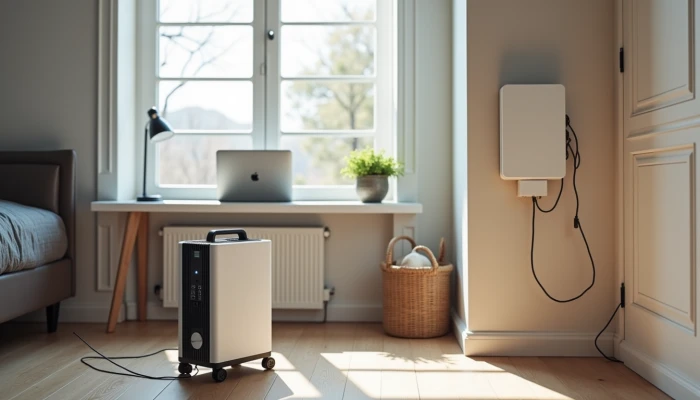
A portable power station is a self-contained battery with built-in outlets and charging controls. You charge it from a wall outlet, and in some cases from solar panels, then plug devices directly into it during an outage. That makes it appealing for backup power for apartments because it does not usually require changes to the building's electrical system.
By contrast, a home battery backup system is normally tied into the home's wiring through professional installation. That can involve wall mounting, dedicated circuits, an inverter, and coordination with the electrical panel. In a rental, those steps are often impractical unless the landlord is unusually supportive and the building can accommodate the work.
In plain terms, the renter-friendly advantages of a portable station are usually these:
- No panel modifications in most use cases
- Easy to store in a closet or corner
- Can move with you to a new apartment
- Useful for outages, travel, car camping, or temporary remote work setups
- Lower commitment if you are unsure how long you will stay
A fixed home battery system offers different strengths, but they matter more when you control the property. It is built for automatic backup, larger loads, and tighter integration with the home. Those are real benefits, but they are harder to access in an apartment setting.
This is the core tradeoff:
| Feature | Portable power station | Home battery system |
|---|---|---|
| Mobility | High | Very low |
| Typical rental fit | Often practical | Often limited |
| Building modifications | Usually none for basic use | Usually significant |
| Move-out flexibility | Easy to take with you | Not portable |
| Backup style | Plug devices in directly | Can support selected home circuits when professionally installed |
Portable units also match the way many renters actually use backup power. Instead of trying to energize every outlet, they power a few essentials: phones, lights, internet gear, laptops, CPAP-adjacent household planning needs, or a small appliance if the station's output allows it. Some sources describing renter scenarios point to roughly 1,000 to 2,000 watt-hours as a common portable range for essential backup, though actual needs vary a lot by device and runtime.
A simple way to decide is to ask yourself whether you need mobility or integration.
- Choose mobility if you want backup power that works in your current apartment and your next one.
- Choose integration only if you have unusual landlord cooperation, long-term plans in the same unit, and power needs that go beyond what a portable station can reasonably handle.
For many renters, a portable power station is not a compromise. It is the format that matches the living situation.
Cost Comparisons: Upfront and Long-Term Considerations
Cost differences between these two categories are large enough that many renters can rule one option out quickly.
Portable power stations are often sold in a range that starts around a few hundred dollars and climbs into the low thousands depending on capacity, output, battery chemistry, and charging speed. Several comparison sources place many mainstream portable units around $500 to $2,500.
Whole-home or professionally installed home battery systems operate on a different budget level. Comparison and marketplace sources commonly place installed systems in a much higher range, often around $13,000 to $30,000, depending on battery size, equipment, and installation complexity.
That gap matters because renters are not just buying electricity storage. They are buying flexibility. A lower-cost portable unit may be easier to justify if:
- You expect to move within a few years
- You only need essentials backup
- You do not have permission for permanent equipment
- You want one device that can serve multiple uses
A home battery system may look more capable on paper, but the economics are harder for renters to defend when the equipment is tied to a property they do not own.
There is also a scale question. Portable stations are usually measured in watt-hours, while home batteries are often discussed in kilowatt-hours. That difference reflects what they are built to do. A portable station may handle a short outage for selected devices. A home battery system is designed for larger energy reserves and more structured backup.
If you are comparing options, use this quick decision framework.
| Question | If your answer is yes | What it points toward |
|---|---|---|
| Will you likely move during the battery's life? | Yes | Portable power station |
| Do you need backup for only a few essentials? | Yes | Portable power station |
| Do you need automatic backup for home circuits? | Yes | Home battery system |
| Can you get landlord approval for permanent electrical work? | Yes | Possibly a home battery system |
| Is your budget limited to the low thousands? | Yes | Portable power station |
Lifespan also affects value. Portable units are often expected to last several years, with many buyer guides and comparison pieces describing a rough range of 5 to 10 years depending on use patterns, battery chemistry, and cycle count. That does not mean every unit will last that long, and it should not be treated as a guarantee. It does mean renters should compare the expected useful life with how long they expect to stay in the apartment and how often they will actually use the system.
If you are trying to estimate size, a simple home battery size calculator approach can help even if you do not buy a fixed home battery. List the devices you care about, note their wattage, and multiply by the number of hours you want to run them. That gives you a rough watt-hour target.
For example:
- Phone charging and lights usually require relatively little energy.
- A router and laptop add a modest ongoing load.
- Refrigerators, microwaves, and heating equipment can change the calculation quickly.
That is why many renters find that their real need is not "backup power for everything" but "backup power for a short list of essentials for a few hours." Once that is clear, the lower upfront cost of a portable station often makes more sense than a full home battery backup installation.
Safety Considerations for Indoor Use
Safety matters more in apartments because you are using backup equipment in tighter indoor spaces and often near other residents.
Portable power stations are commonly marketed for indoor use because they do not burn fuel and do not produce the exhaust risks associated with generators. That is a major reason they are often part of the generator vs battery backup conversation for renters. But "safer than a " does not mean "use however you want."
You still need to follow the manufacturer's instructions on placement, charging, temperature limits, and ventilation. Some guidance for lithium-based battery products recommends keeping the unit in a dry, stable location and avoiding blocked vents, direct heat, or enclosed spaces that trap heat.
A practical apartment safety checklist looks like this:
- Use the unit only as the manufacturer describes
- Keep it away from water, heaters, and direct sunlight
- Do not cover vents or place it in a tightly sealed cabinet while operating or charging
- Use only approved charging accessories and cables
- Do not overload the AC output beyond the unit's rating
- Store it where it will not block exits or create a trip hazard
- Check building rules before charging large battery devices in shared areas
Home battery systems are also designed with safety controls, but they are not casual plug-and-play devices. Their safety depends heavily on proper design, approved equipment, and professional installation. In a rental, that usually means landlord approval, building suitability, and qualified electrical work. Those requirements are one reason home battery systems are uncommon in apartments.
It also helps to separate batteries from generators in your planning. A fuel-burning generator should never be used indoors, on enclosed balconies, or in other spaces where exhaust can accumulate. Renters comparing backup power options sometimes treat all backup devices as interchangeable, but they are not. Battery systems and generators have very different safety rules.
Another important point is load realism. A portable station may be safe to use indoors when used correctly, but that does not mean it can run every apartment appliance. High-draw devices can exceed the inverter's output or drain the battery quickly. Safety includes matching the battery to the load instead of forcing the battery to do more than it is designed for.
When in doubt, verify three things before buying:
- Where it can be used: indoor, outdoor, or both
- What it can power: continuous watt rating and surge limits
- How it should be charged and stored: especially in small apartments
For renters, the safest backup setup is usually the one that stays within the manufacturer's intended use and does not require improvised wiring, overloaded outlets, or unapproved building modifications. If you are considering anything beyond a portable plug-in setup, it is wise to check with your landlord and a qualified electrician rather than assuming a home battery system can be added later without complications.
Conclusion
For apartment renters, the choice usually comes down to flexibility versus integration.
A portable power station is often the more practical fit because it is movable, lower cost, and usable without permanent electrical changes in many situations. It works well when your goal is to keep a few essentials running during outages and take the equipment with you when you move.
A home battery backup system can offer deeper backup capability, but it is usually better suited to people who control the property, can get professional installation, and need support for larger or more structured loads. In a rental, those conditions are harder to meet.
If you are unsure, start by estimating your critical loads instead of your entire apartment. That simple step often makes the decision clearer. Many renters discover that a portable unit covers the most important needs without the cost, complexity, or approval issues of a fixed home battery system.
Whichever route you consider, keep expectations realistic, follow manufacturer safety guidance, and confirm any building or electrical requirements before making a purchase.