How to Keep a Backup Battery from Tripping During an Outage
A home battery backup can make an outage much easier to live through, but only if the system is asked to do a realistic job. Many overload problems happen because too many appliances try to run at once, or because high-draw equipment is included in backup plans without checking whether the battery and inverter can support it.
The practical fix is not guessing. It is planning. That means identifying your critical loads, separating them from non-essential circuits, and using the right system design so the battery serves the most important parts of the home first.
This guide explains what critical loads are, how a backup subpanel helps manage them, and what an automatic transfer switch does during an outage. The goal is to help you prepare for power outage preparation conversations with an installer and better understand how much battery backup do I need before you rely on a system in a real blackout.
What Are Critical Loads and Why They Matter
Critical loads are the appliances and circuits you want powered first when the grid goes down. In most homes, these are the loads tied to safety, food storage, water access, basic lighting, communication, or heating equipment controls.
Common examples include the refrigerator, freezer, internet equipment, a few lighting circuits, a furnace blower or boiler controls, a sump pump, a well pump, and any essential medical-support equipment that has been specifically reviewed with qualified professionals and manufacturer guidance.
Just as important is knowing what usually does not belong on a limited backup system. Large electric resistance loads and comfort loads can drain stored energy quickly or exceed the inverter's power output. That often includes central air conditioning, electric water heaters, electric dryers, ovens, and other heavy appliances unless your system was intentionally designed and sized for them.
A simple way to think about it is this:
- Critical loads keep the home functional and reduce immediate disruption.
- Non-essential loads are convenient, but not necessary for short-term outage resilience.
- High-draw loads may be essential in some homes, but they need special attention because they can push a battery system into overload.
If you are not sure what belongs in each category, start with a short written list. This can help before using any home battery size calculator or speaking with an installer.
| Load type | Typical examples | Why it matters for outage planning |
|---|---|---|
| Critical | Fridge, freezer, some lights, router, furnace controls, sump pump | Keeps food safe, preserves basic comfort, supports communication and safety |
| Conditional | Well pump, garage door opener, microwave, small window AC | May be important, but should be checked for runtime and startup demand |
| Usually non-essential for battery backup | Electric water heater, dryer, oven, large central AC, pool equipment | Can use too much power too quickly and shorten backup time |
Capacity planning is not only about total battery energy. It is also about whether the system can handle the momentary and continuous power demand of the loads you choose. Guidance commonly emphasizes adding up expected daily energy use for essential circuits and checking peak power needs separately. That is why two homes with the same battery size can have very different outage results.
If you want a practical starting point, make a list of the loads you truly need for 24 hours, then ask:
- Does this load need to run during every outage?
- Does it run continuously, occasionally, or only for short bursts?
- Does it have a motor or compressor that may need extra startup power?
- Could I live without it until grid power returns?
That short exercise usually reveals where overload risk comes from. It is often not the number of devices, but one or two large loads that were never screened out.
Subpanel Configuration Basics for Battery Backup
A backup battery works more predictably when only selected circuits are connected to it. That is where a dedicated subpanel comes in.
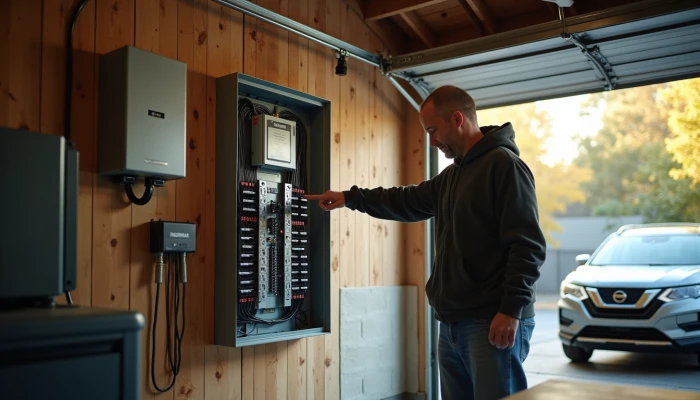
A subpanel is a smaller electrical panel that serves a chosen group of circuits. In a battery backup setup, the idea is straightforward: move only the circuits you want backed up into that panel, and leave the rest on the main panel. This helps prevent the battery from trying to support the entire home during an outage.
Implementation guidance often describes this as the standard way to manage critical loads. Instead of feeding every circuit, the battery-backed system serves a focused set of essentials.
In plain terms, a backup subpanel helps by:
- Limiting what the battery can power during an outage
- Stretching stored energy across the loads that matter most
- Reducing the chance that a large appliance will trip the system
- Making outage behavior more predictable for the homeowner
Typical circuits that may be placed on a backup subpanel include:
- Refrigerator or freezer circuit
- Selected lighting circuits
- Internet and communication equipment
- Furnace blower or boiler controls
- Sump pump or well pump, if the system is designed for it
- A few convenience outlets for charging phones or small devices
Loads that often stay off the backup subpanel unless capacity is clearly verified include:
- Electric water heaters
- Electric ranges and ovens
- Clothes dryers
- Large HVAC equipment
- EV charging circuits
- Pool pumps or workshop tools
This does not mean those larger loads can never be backed up. It means they should not be assumed safe to include without careful load review.
Use this checklist before discussing your setup with a professional:
- List the circuits you want available in an outage
- Mark which ones are essential for safety, water, refrigeration, or heat
- Flag any motor-driven or high-wattage loads
- Ask whether each load belongs on the backup subpanel or should stay on the main panel
- Confirm both runtime needs and peak power needs
- Ask what happens if multiple selected loads start at the same time
For homeowners comparing proposals, this is one of the most useful questions to ask: Which exact circuits will be on the backup subpanel, and which will not?
That question usually leads to a clearer answer than asking whether a system provides whole-home battery backup. In many homes, so-called whole-home backup still depends on careful load management, staged operation, or excluding certain heavy loads. The label matters less than the actual circuit plan.
How Automatic Transfer Switches Prevent Overload
An automatic transfer switch, often called an ATS, is the device that changes your home from normal grid power to backup power when an outage happens. Its job is not to create more battery capacity. Its job is to direct power safely and make sure only the intended circuits are energized.
In a properly designed system, the ATS works with the battery and inverter so the backup subpanel is supplied during an outage while non-backed-up circuits remain isolated. That isolation is a big part of overload prevention.
Without that separation, the battery could be exposed to more household demand than it was meant to handle. With it, the system is limited to the selected critical loads.
Here is the basic sequence:
- Grid power fails.
- The transfer equipment detects the outage.
- The home switches from utility supply to battery-backed supply for the designated circuits.
- Non-critical circuits stay disconnected from backup power.
Some guidance describes this switchover as happening very quickly, which helps maintain service to selected loads. But speed is only part of the benefit. The larger benefit for most homeowners is controlled power routing.
A good way to understand the ATS is to compare outage behavior with and without load control.
| Setup | What happens in an outage | Overload risk |
|---|---|---|
| No clear critical-load separation | Too many circuits may try to draw power | Higher |
| Backup subpanel plus ATS | Only selected circuits receive backup power | Lower |
| Large loads included without verification | Battery may trip or deplete quickly | Higher |
This is also why professional system design matters. Even if your battery has enough stored energy in kilowatt-hours, the inverter still has output limits. A refrigerator, sump pump, and furnace blower may be fine together in one home, but adding another motor load at the same moment could change the picture. An ATS does not eliminate those limits. It helps enforce the plan built around them.
When reviewing a proposal, ask practical questions such as:
- Which circuits will the ATS transfer during an outage?
- Will any large loads be locked out from battery power?
- How does the system handle simultaneous startup loads?
- Is the design based on both energy use and peak power demand?
Those questions help you move beyond marketing terms and focus on real outage performance. For most households, the safest path is not trying to power everything. It is making sure the right things stay on without overloading the system.
Conclusion
Avoiding battery overload during an outage usually comes down to one decision: power the essentials first, not everything at once. Defining critical loads, placing those circuits on a dedicated subpanel, and using an automatic transfer switch to isolate non-essential loads can make a home battery backup far more usable when the grid is down.
If you are planning a system or reviewing quotes, focus on the actual circuits, runtime expectations, and peak power limits rather than broad claims about whole-home coverage. A licensed electrician or qualified installer can help confirm whether your backup plan matches your panel layout, local code requirements, and the real demands of your appliances.