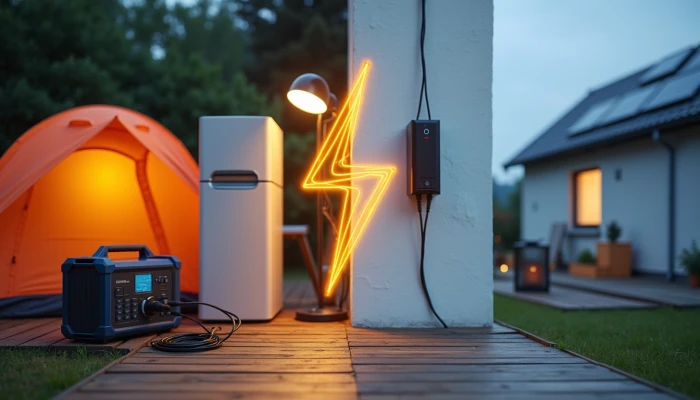
Portable Power Stations Vs. Home Battery Backups: Which Fits Your Backup Plan?
If you are comparing a portable power station with a home battery backup, you are really deciding between two different kinds of resilience.
One is flexible and movable. The other is fixed and built into the home. Both can help during outages, but they are not interchangeable in every situation.
For many households, the main question is not which option is "better." It is which one matches your living situation, essential loads, budget, and tolerance for installation work. A renter in an apartment may need a very different setup than a homeowner who wants automatic backup for a well pump, refrigerator, and a few lighting circuits.
This guide walks through the core differences, practical use cases, installation requirements, and cost tradeoffs so you can narrow the field before talking with an installer or buying equipment.
Understanding the Core Differences: Portable Power Stations vs Home Battery Systems
A portable power station is a self-contained battery unit with built-in outlets, charging ports, and an inverter. In plain terms, it stores electricity and lets you plug devices directly into it. Many are designed for mobility, temporary backup, and simple charging from a wall outlet, a car, or portable solar panels.
A home battery system is different. It is a fixed installation connected to your home's electrical system. It usually works with an inverter and may be paired with a transfer switch or a critical loads panel so selected circuits keep running during an outage. Some systems are also designed to work with rooftop solar.
The biggest practical differences are these:
- Portability: A power station can move from room to room or travel with you.
- Integration: A home battery backup is tied into the house for more seamless operation.
- Capacity and output: Portable units are usually meant for device-level or small-appliance backup, while home batteries are built for larger loads and longer coverage.
- Automation: Home battery systems can switch on automatically during an outage. Portable units usually require you to plug things in manually.
A simple way to think about it is this:
| Feature | Portable power station | Home battery system |
|---|---|---|
| Main role | Temporary, flexible backup | Integrated home backup |
| Setup | Plug-and-play | Professional installation |
| Typical use | Devices, small appliances, short outages | Critical circuits, longer outages, solar integration |
| Mobility | High | None once installed |
| Automatic backup | Usually no | Often yes |
That does not mean portable systems are only for light use. Some larger models can run a refrigerator or support modular expansion. But the overall category is still centered on flexibility rather than full-home integration.
Use Case Scenarios: When Each Option Makes Sense
The right choice becomes clearer when you start with the job the battery needs to do.
A portable power station often makes sense when your goal is to keep a few essentials running during a short outage. That might include charging phones, powering internet equipment, running a CPAP only if the manufacturer and your care team confirm compatibility, or keeping a refrigerator cold for a limited period if the unit has enough surge and runtime capacity. It can also be useful for renters, apartment residents, and households that cannot install permanent equipment.
A home battery system usually makes more sense when you want backup to happen automatically and support selected household circuits without moving cords around. This is often the better fit for homeowners who want to cover refrigeration, lighting, internet, garage door operation, some outlets, and possibly equipment like a sump pump or well pump if the system is sized correctly.
Here is a practical scenario guide:
| Situation | Better fit | Why |
|---|---|---|
| Apartment or rental with no permanent installation | Portable power station | No hardwiring required |
| Short outages and a few small essentials | Portable power station | Lower upfront commitment |
| Want automatic backup for key circuits | Home battery system | Integrated switching and circuit support |
| Already have or plan to add solar | Home battery system | Better fit for solar plus battery setups |
| Need backup in multiple places, including travel or outdoors | Portable power station | Mobility matters |
| Rural home with repeated outages | Often home battery, sometimes hybrid | More capacity and better home integration |
Some households may end up with a hybrid approach.
For example:
- A fixed battery handles critical home circuits.
- A portable power station covers extra devices, detached spaces, or temporary needs.
- Portable solar panels may help recharge a small unit during extended outages, depending on weather and equipment limits.
This is also where the question "how much battery backup do I need" becomes more useful than comparing product categories in the abstract. Start with your loads, not the marketing label. A refrigerator, freezer, modem, and a few lights call for a very different plan than central air conditioning or electric resistance heat.
If you are trying to estimate needs before requesting quotes, a simple home battery size calculator approach is to list:
- What must stay on.
- How many hours you want backup.
- The running watts and startup surge of each item.
- Whether you need automatic whole-circuit backup or just temporary plug-in power.
That exercise often reveals whether a portable unit is enough or whether a home battery system is the more realistic path.
Installation Complexity and Permits
Installation is one of the clearest dividing lines between these options.
Portable power stations are usually simple to start using. You charge them, place them in an appropriate location, and plug devices into the built-in outlets. That simplicity is a major advantage for households that want backup without electrical work.
But simple does not mean risk-free. Portable systems still have manufacturer limits on output, charging, placement, and indoor use. Safety guidance commonly emphasizes keeping units in suitable conditions, avoiding blocked ventilation, and following the manufacturer's instructions for charging and storage.
Home battery systems are more involved. They are typically connected to the home's electrical infrastructure and may require:
- A licensed electrician or installer
- A transfer switch or other approved switching equipment
- Possible service panel or subpanel work
- Local permits and inspections
- Utility or authority review in some cases
This is especially important if the battery is intended to back up hardwired loads. A professionally installed system is not just about convenience. It is also about code compliance, safe operation, and making sure the battery, inverter, and protected circuits are matched correctly.
A useful rule of thumb is:
- Choose a portable power station if you want to avoid permanent wiring.
- Expect professional involvement if you want a battery to power home circuits automatically.
Do not assume that a larger portable unit can simply be tied into household wiring without approved equipment and qualified help. Likewise, do not assume every home battery setup is the same. Requirements can vary by home layout, electrical service, local code, and whether solar is part of the design.
Cost Per kWh and Long-Term Value
Cost is not just about the sticker price. It is also about how much usable storage and power capability you get for the money, and whether the system fits your actual needs.
Source material reviewed for this topic places installed home battery systems at roughly $500 to $1,300 per kWh in many residential scenarios, with whole-home battery projects often landing around $6,000 to $18,000 before incentives. Other comparison material points to higher installed costs in some setups, especially as capacity, complexity, and home backup scope increase.
Portable power stations usually have a lower entry price because they do not include installation. But expansion can get expensive. Some models support add-on battery packs, and reviewed sources note that these extra packs often cost about $600 to $1,200 each, depending on the system.
The value question is easier to answer with a side-by-side framework:
| Cost factor | Portable power station | Home battery system |
|---|---|---|
| Upfront entry cost | Usually lower | Usually higher |
| Installation cost | Minimal or none | Significant compared with portable units |
| Cost to expand | Can be high per added battery pack | Can also be high, but may scale better for home use |
| Cost per convenience | Lower automation | Higher automation and integration |
| Long-term fit for solar and TOU shifting | Limited in many cases | Often much stronger |
Long-term value depends on what you are trying to accomplish.
A portable unit can be the better value if:
- You only need occasional outage backup.
- You want to power a few devices or one appliance at a time.
- You are not staying in the home long term.
A home battery backup may offer better long-term value if:
- Outages are frequent enough that automation matters.
- You want backup for multiple circuits.
- You plan to pair storage with solar plus battery operation.
- You want to shift some energy use around time-of-use electricity rates, where available and if your system supports it.
The mistake to avoid is comparing only raw battery capacity. Inverters, surge handling, installation, transfer equipment, and circuit integration all affect real-world usefulness. A cheaper kWh is not automatically the better household solution.
Pros and Cons: Weighing Tradeoffs for Your Home
Both options have real strengths. Both also have limits that matter once you move beyond phone charging and start thinking about refrigerators, pumps, heating equipment, or longer outages.
Here is a practical tradeoff summary:
| Option | Main advantages | Main limitations |
|---|---|---|
| Portable power station | Flexible, movable, fast to deploy, no permanent installation | Usually lower capacity, manual operation, limited support for hardwired loads |
| Home battery system | Automatic backup, cleaner integration, better for critical circuits and solar | Higher upfront cost, professional installation required, less flexible once installed |
Portable power stations are attractive because they are easy to understand and easy to buy. For many people, that is enough. If your real goal is to keep internet, lights, phones, and maybe one kitchen appliance going during a short outage, a portable unit may be the simplest answer.
Home battery systems become more compelling when reliability and convenience matter more than mobility. If you want backup to start automatically when the grid goes down, or you need support for selected circuits without running extension cords through the house, a fixed system is usually the better fit.
There are also load-specific limits to keep in mind.
High-demand equipment such as these may require careful sizing or may be impractical for smaller systems:
- Well pumps
n- Sump pumps with high startup surge - Electric furnaces or electric resistance heating
- Central air conditioning
- Large kitchen appliances running at the same time
Before you decide, use this quick checklist:
- Do I need backup for devices, or for home circuits?
- Do I want automatic switchover during an outage?
- Am I renting or do I own the property?
- How often do outages happen here?
- Which loads are truly essential?
- Do I need portability outside the home?
- Am I planning to add solar later?
- Can I justify the higher installed cost of a fixed system?
If most of your answers point toward flexibility and light-duty backup, portable likely fits better. If they point toward automation, circuit-level backup, and longer-term resilience, a home battery system is usually the stronger match.
Conclusion
Choosing between a portable power station and a home battery backup comes down to matching the tool to the job.
Portable units are often the practical choice for renters, smaller backup needs, and households that want a simple, movable power source for occasional outages. Home battery systems are usually the better fit when you want automatic backup, support for critical circuits, and a setup that can work with solar or broader home energy goals.
If you are still unsure, start by listing your essential loads and outage priorities. That will tell you more than any marketing label. Then ask a qualified installer or electrician to confirm sizing, compatibility, permit needs, and safety requirements before committing to a hardwired system.