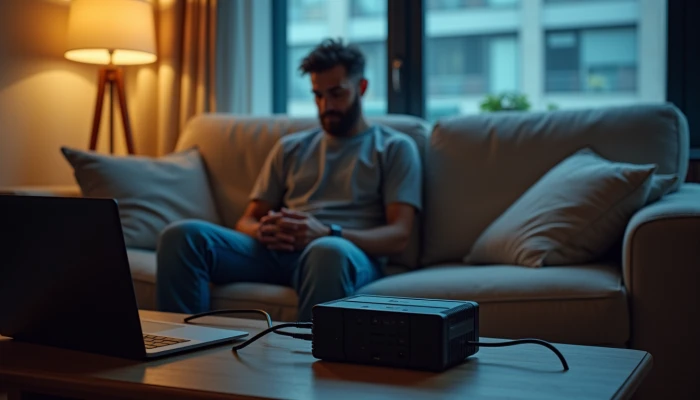
Rental-Friendly Backup Power When Generators Aren’t an Option
If you rent an apartment, backup power planning usually looks different from what you see in guides written for single-family homes. You may not have a garage, yard, or permission to install anything permanent. And in many buildings, gas generators are either explicitly banned or clearly unsafe to use.
That leaves many renters looking for a practical middle ground: something safer and simpler than a fuel-burning generator, but more useful than a handful of phone power banks. For many households, that middle ground is a portable power station.
This kind of home battery backup is not a whole-home solution. It will not run every appliance in an apartment indefinitely. But it can help keep a few critical loads going during an outage, such as phones, internet gear, lights, small medical-adjacent electronics that follow manufacturer guidance, or in some cases a refrigerator for a limited period.
The key is to match your expectations to your actual needs, your building rules, and the unit’s rated output and storage capacity.
Why Gas Generators Are Problematic in Apartments
Gas generators are a poor fit for most apartment settings for both safety and policy reasons. Even when a renter is focused on emergency preparedness, apartment buildings usually have shared walls, limited outdoor space, and rules designed to reduce fire, fumes, and noise risks.
The biggest issue is carbon monoxide. Fuel-burning generators produce exhaust that can become deadly in enclosed or semi-enclosed areas. That is why indoor use is unsafe, and why balconies, breezeways, parking structures, and areas near windows or doors may also be restricted by building rules or local safety guidance.
Noise is another practical problem. Apartment communities often have quiet-hour rules, nuisance policies, or lease language that limits loud equipment. A generator that might be tolerated on a large rural property can create immediate problems in a dense building.
Landlords and property managers also tend to ban fuel storage, open-flame risks, or equipment that could create liability during an outage. Even if your lease does not mention generators by name, general safety clauses may still limit their use.
For renters, the takeaway is simple:
- Do not assume a generator is allowed just because you own one.
- Do not assume a balcony or hallway makes generator use safe.
- Do not use a fuel-burning or in enclosed building spaces.
- Check your lease, building notices, and local fire-safety guidance before buying any backup equipment.
This is why apartment backup planning usually shifts away from fuel-based systems and toward smaller, self-contained options that do not require combustion, refueling, or permanent installation.
Portable Power Stations: The Apartment-Friendly Alternative
Portable power stations are battery-based units that store electricity and deliver it through built-in outlets, USB ports, and sometimes higher-power AC outputs. For renters, their biggest advantage is that they are usually zero-install backup power options. You charge them ahead of time, store them in the apartment, and use them when the grid goes down.
That makes them very different from hardwired backup systems. There is no electrical panel work, no transfer switch, and no landlord approval for permanent modifications in the typical use case. You are simply plugging devices into the unit, the same way you would plug them into a wall outlet during normal conditions.
Portable power stations also avoid the combustion risks that make gas generators such a bad fit for apartment living. Many current models use LFP battery chemistry, also called lithium iron phosphate battery or LiFePO4. Manufacturer guidance and safety-focused materials commonly describe LFP as a more stable chemistry than some other lithium battery types, especially when paired with built-in protections against overloading, overheating, and short circuits.
That does not mean every unit is equally suitable. It does mean the category offers clear portable power station benefits for renters:
- No fuel storage
- No engine noise
- No exhaust emissions during use
- No permanent installation
- Easy storage in a closet or utility area
- Ability to move the unit if you relocate
A portable power station can be useful for critical loads such as:
- Phones and tablets
- Wi-Fi router and modem
- LED lamps
- Laptop charging
- CPAP-style consumer backup use only if manufacturer guidance is followed and medical advice comes from the appropriate provider
- Small fans
- In some cases, a refrigerator, freezer, sump pump, or similar appliance if the unit’s output and surge capacity match the appliance requirements
That last point matters. A battery backup for refrigerator use is possible in some setups, but not automatic. Refrigerators have startup surges, and run time depends on battery size, room temperature, door openings, and compressor cycling. The same caution applies to pumps and other motor-driven loads.
So while portable power stations are often the most apartment-friendly backup option, they work best when you treat them as a targeted critical-load tool rather than a promise of full-apartment backup.
Key Considerations for Choosing a Portable Power Station
Choosing a unit starts with one question: what do you actually need to keep running during an outage? Many renters overbuy based on marketing or underbuy based on price alone. A better approach is to list only the loads that matter most.
If you are asking, how much battery backup do I need, start with a simple load list. Write down each device, its running watts if known, and roughly how many hours you want to use it during an outage.
A basic planning sequence looks like this:
- List your essential devices.
- Check each device label or manual for wattage.
- Note whether the device has a motor or compressor that may need extra startup power.
- Estimate how many hours you want each device to run.
- Compare that total with the power station’s output rating and battery capacity.
You can think of a home battery size calculator as a planning method rather than a specific tool. The goal is to match two things:
- Power output: how much the unit can supply at one time
- Energy capacity: how long it can keep supplying that power
This quick table can help renters narrow their options.
| What to check | Why it matters in an apartment |
|---|---|
| AC output rating | Determines whether the unit can run your device at all |
| Surge capability | Important for appliances with compressors or motors |
| Battery chemistry | LFP batteries are often preferred for durability and thermal stability |
| Weight and handles | Easier to move, store, and carry during a move |
| Charging options | Wall charging is the most relevant for many renters |
| Safety certifications | Helps you screen for more established designs |
| Storage footprint | Large units may be hard to store in small apartments |
It also helps to separate realistic apartment loads from unrealistic ones.
More realistic uses often include:
- Charging personal electronics
- Running internet equipment
- Powering lights
- Supporting a few low-watt devices
Less realistic uses for many portable units include:
- Running all kitchen appliances at once
- Powering electric resistance heating for long periods
- Covering every circuit in the apartment
- Acting as a whole-home battery backup equivalent
If you are considering a refrigerator, freezer, or pump, verify both the running wattage and startup surge from the appliance documentation if possible. If the information is unclear, ask the manufacturer before assuming compatibility.
Finally, think about your living constraints. A unit that looks ideal on paper may be too heavy for a walk-up apartment, too bulky for your storage space, or too slow to recharge for your outage pattern.
Safety and Maintenance Practices for Portable Power Stations
Portable power stations are generally designed to be user-friendly, but safe use still matters. Most safety guidance across manufacturers and technical explainers is consistent: use the equipment as directed, avoid physical damage, and pay attention to heat, charging conditions, and storage.
Start with the manual. Use the charger, cable, and charging method recommended by the manufacturer. Avoid improvising with damaged cords, loose outlets, or overloaded power strips. During charging, keep the unit uncovered and in a stable, ventilated location.
For apartment use, this checklist is a good baseline:
- Charge the unit with manufacturer-approved accessories.
- Keep it away from water, direct heat, and flammable materials.
- Do not block vents while charging or discharging.
- Stay within the manufacturer’s temperature guidance.
- Do not exceed the rated output wattage.
- Inspect the case, ports, and cables regularly.
- Stop using the unit if you notice swelling, unusual odor, smoke, or excessive heat.
Storage matters too. A cool, dry area is usually the safest choice. Do not leave the unit in a hot car for long periods, and do not store it where it can be crushed, punctured, or knocked over. If your apartment has limited space, choose a location where the unit is easy to access but not in the way of daily traffic.
Routine maintenance is simple but important:
- Recharge the unit according to the manufacturer’s storage recommendations.
- Check charge level periodically if it is stored for emergencies.
- Inspect for dust, debris, or port damage before an outage happens.
- Review the manual occasionally so you remember the unit’s limits.
A few common mistakes are worth avoiding.
| Mistake | Better approach |
|---|---|
| Assuming all lithium batteries behave the same | Check the battery chemistry and manufacturer guidance |
| Using random third-party chargers | Use approved charging equipment |
| Treating the unit like a full-home system | Reserve it for critical loads |
| Storing it fully forgotten in a closet | Check charge status on a schedule |
| Ignoring heat, swelling, or odor | Stop use and contact the manufacturer |
If your building has specific battery storage rules, ask management for clarification. Portable power stations are often easier to accommodate than generators, but building policies still vary. It is better to confirm expectations before an emergency than during one.
Conclusion
For apartment renters, backup power usually has to be simple, portable, and non-combustion based. That is why portable power stations are often the most practical fit. They offer a flexible way to cover a few essentials without permanent installation, fuel handling, or the safety problems tied to gas generators in shared buildings.
The main limitation is also the main planning step: know your loads. A portable unit can be very useful for critical devices, but it is not a substitute for a professionally designed whole-home system. If you size it around your real outage priorities, store it properly, and follow manufacturer guidance, it can be a solid part of your outage plan.
Before buying, confirm your apartment’s rules, review the unit’s safety instructions, and double-check compatibility for any higher-demand appliance you hope to run.