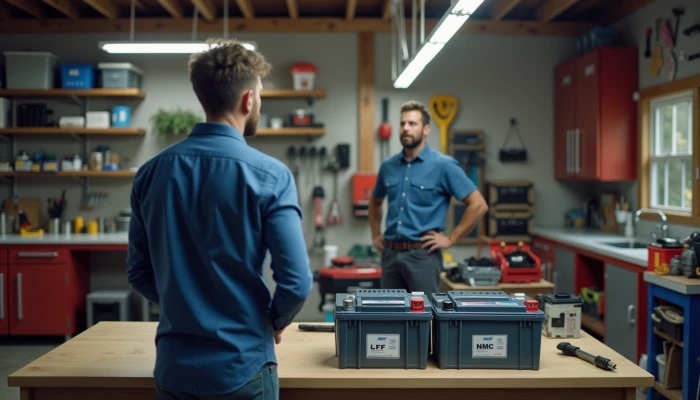
How to Choose Between Lfp and Nmc for Home Battery Storage
If you're comparing battery options for home battery backup, one of the most important differences is the battery chemistry inside the system. Two common types are LFP battery systems, also called lithium iron phosphate battery systems, and NMC systems.
For most homeowners, the choice is not about chemistry for its own sake. It is really about a few practical questions: How long will the battery hold up? How quickly will it lose capacity? How does it behave in heat or cold? And what safety tradeoffs come with each option?
A battery installer or product page may not explain those differences clearly. Some systems also focus more on compact size, while others emphasize long service life and simpler long-term ownership.
This comparison looks at the main decision points that matter in residential storage:
- cycle life differences
- degradation rates over time
- safety profiles under stress and heat
- temperature performance in real-world conditions
The goal is not to declare one chemistry universally better. It is to help you match the chemistry to your home, climate, outage needs, and expectations for long-term use.
Cycle Life Differences: Longevity and Replacement Frequency
Cycle life is the number of full charge-and-discharge cycles a battery can go through before its usable capacity drops to a stated level, often 80% of the original rating. That does not mean the battery stops working at that point. It means it stores less energy than when it was new.
Across the sources reviewed, LFP usually comes out ahead on cycle life. Manufacturer and industry comparison materials commonly place LFP in roughly the 2,000 to 6,000 cycle range before reaching 80% capacity. NMC is often listed closer to 1,000 to 2,000 cycles, with some summaries showing lower ranges depending on how the battery is used.
For a homeowner, that difference matters because a battery used daily for solar self-consumption or time-of-use shifting will accumulate cycles much faster than a battery used only during occasional outages. If you expect frequent cycling, longer cycle life can mean a longer useful service period before the battery feels noticeably smaller.
A simple way to think about it is this:
- LFP tends to fit homes that want frequent use over many years.
- NMC can still work well, but its shorter cycle life may matter more if the battery is charged and discharged often.
This is also where the home battery warranty becomes important. Some warranties are limited by years, while others also include energy throughput or cycle-related limits. A battery with a long stated lifespan is more meaningful when the warranty terms support the way you plan to use it.
Use this quick comparison when reviewing product literature.
| Factor | LFP | NMC |
|---|---|---|
| Typical cycle life to 80% capacity | Usually higher | Usually lower |
| Fit for frequent daily cycling | Often stronger | More use-dependent |
| Replacement pressure over time | Generally lower | Generally higher |
| Importance of checking warranty details | High | High |
The practical takeaway is simple: if your battery will be used often, cycle life deserves more attention than headline storage capacity alone.
Degradation Rates: Capacity Loss Over Time
Degradation is the gradual loss of battery capacity as the battery ages and cycles. Even if two batteries start with the same usable storage, they may not deliver the same amount of energy a few years later.
The sources reviewed generally describe LFP as degrading more slowly under normal stationary storage conditions. Research and industry analysis also point to better structural stability in LFP cells, which helps explain why they often retain capacity longer. NMC can degrade faster, especially when exposed to higher temperatures or more demanding operating conditions.
For home energy storage, this affects more than the spec sheet. It changes what the battery can actually do later in life. A battery that degrades more slowly is more likely to keep supporting your planned critical loads for longer, whether that means refrigeration, internet equipment, lighting, or part of a heating system.
This matters most in homes that plan to use the battery in one of these ways:
- daily solar-plus-storage cycling
- time-of-use rate shifting
- frequent outage support in unstable grid areas
- long ownership horizons where reduced capacity would be noticeable
If your battery is mainly for rare emergencies, degradation still matters, but the difference may feel less immediate than it would in a daily-use setup.
A useful buying habit is to compare these three points side by side:
- The battery's starting usable capacity.
- The warranty's end-of-warranty capacity retention terms, if stated.
- Whether your expected loads would still fit if the battery had less capacity years from now.
That last point is easy to overlook. A battery that seems large enough today may feel tighter later if your backup plan leaves no margin.
So while broad claims about lifetime savings should be treated carefully, slower degradation can still be a meaningful ownership advantage because it helps preserve usable energy over time.
Safety Profiles: Thermal Stability and Risk Mitigation
Safety is one of the biggest reasons homeowners ask about LFP versus NMC. Both are lithium-ion chemistries, and both rely on battery management systems, proper installation, and manufacturer safeguards. Neither should be treated casually. But they do have different inherent safety characteristics.
The sources reviewed consistently describe LFP as having stronger thermal stability. In plain language, that means it is generally less prone to overheating and less likely to enter thermal runaway under abuse or extreme conditions. NMC can offer strong performance, but it is generally considered more sensitive to heat and more vulnerable under severe stress.
That does not mean LFP is risk-free or that NMC is automatically unsafe. It means chemistry is one part of the overall safety picture.
For homeowners, the practical safety checklist should include more than chemistry alone.
- Look for recognized safety certifications and listing details for the full system, not just the cells.
- Ask where the battery can be installed and what clearance or ventilation rules apply.
- Confirm whether the installer has experience with the specific battery type and enclosure design.
- Review local code, utility, and fire-safety requirements before installation.
- Ask how the system handles overheating, fault detection, and shutdown events.
Safety can also affect comfort with indoor or attached-garage installation, though the final answer depends on the specific product, enclosure, location, and local rules. That is why it is better to think in terms of relative safety profile rather than absolute safety claims.
In short, LFP usually has the edge in thermal stability, which is one reason it is often favored for stationary home storage. But the safer choice in practice is still the one that combines appropriate chemistry, certified equipment, and qualified installation.
Temperature Performance: Efficiency in Extreme Conditions
Temperature can change both short-term performance and long-term battery wear. This is especially important if the battery will be installed in a garage, utility room, exterior enclosure, or another space that is not tightly climate controlled.
In hotter conditions, the sources reviewed generally indicate that LFP handles heat better from a longevity standpoint. It tends to generate less concern around heat-related degradation, which can make it attractive in warm climates or in installations where summer temperatures are a regular stress factor.
Cold weather is more nuanced. Some comparisons note that NMC can perform more evenly across a wider temperature range, while LFP can see a more noticeable drop in cold-weather performance. Other sources specifically warn that NMC can lose substantial capacity below freezing without active heating. The practical lesson is not that one chemistry wins in every cold-weather scenario. It is that low-temperature behavior depends heavily on the full system design, including heating controls and battery management.
If you live in a climate with temperature extremes, ask these questions before choosing a system:
- Will the battery be installed in conditioned space or in a location exposed to seasonal extremes?
- Does the system include active thermal management or battery heating?
- Are the charging and discharging limits reduced in cold weather?
- Does the manufacturer publish operating and charging temperature ranges clearly?
- Will your backup plan still work if winter performance is temporarily reduced?
A simple decision framework can help:
| Your situation | Chemistry may be easier to live with | Why |
|---|---|---|
| Frequent cycling in hot conditions | LFP | Better reputation for heat tolerance and slower degradation |
| Tight space where compact energy storage matters more | NMC may appeal | Higher energy density can help reduce size |
| Cold climate with strong thermal management built in | Depends on system design | Heating and controls may matter as much as chemistry |
| Long-term stationary backup priority | LFP often fits | Longevity and thermal stability are often stronger |
This is also where energy density enters the conversation. NMC's higher energy density means more storage in less space, which can matter if installation space is limited. LFP usually trades some compactness for longer life and stronger thermal stability.
For most homes, the right question is not "Which chemistry handles temperature best in theory?" It is "Which system is designed well for the place where it will actually be installed?"
Conclusion
Choosing between LFP and NMC comes down to which tradeoffs matter most in your home.
LFP usually stands out for:
- longer cycle life
- slower degradation over time
- stronger thermal stability
- a good fit for long-term stationary use
NMC usually stands out for:
- higher energy density
- potentially more compact storage for the same footprint
- use cases where space constraints matter more than maximum lifespan
For many homeowners comparing home energy storage, LFP will look appealing because home systems often prioritize longevity, safety, and dependable performance over compact size. But that does not make NMC the wrong choice in every case.
Before you decide, compare the full system rather than the chemistry label alone. Review warranty terms, installation location, temperature controls, certifications, and how much capacity you will still need after years of normal degradation.
If you're narrowing down quotes, ask the installer to explain how the battery chemistry affects expected lifespan, capacity retention, and placement requirements in your specific home. That usually leads to a better decision than focusing on a single headline spec.